

Categories5 Points Blog

Why More Northeast Ohio Rental Property Investors Are Trading Up From Cleveland to Suburbs Like Mentor

For decades, Cleveland has attracted real estate investors for a simple reason:

Low acquisition prices can create attractive rental yields.

That basic formula still works in the right neighborhood, with the right property, at the right price.

But experienced rental property investors eventually learn that cash flow on paper and cash flow in the bank are two very different things.

A property may show an impressive projected return when purchased.

Then reality arrives.

A furnace fails.

A century-old sewer line backs up.

A tenant stops paying.

A turnover requires more work than expected.

Another city inspection comes due.

Lead-safe requirements have to be addressed.

Insurance increases.

The roof needs replacement.

The electrical panel is obsolete.

A contractor opens a wall and discovers another problem.

Before long, the investor who originally focused almost entirely on purchase price and monthly rent begins asking a different question:

What kind of rental property do I actually want to own for the next 10 or 20 years?

That question is helping push some Northeast Ohio investors outward—from Cleveland proper toward suburban and outer-ring communities such as Mentor, Ohio.

The Investor Evolution: From Maximum Yield to Better Quality Income

Many investors begin by chasing the highest possible cash-on-cash return.

That naturally leads them toward inexpensive houses.

If one property costs $80,000 and rents for $1,200 while another costs $225,000 and rents for $1,800, the $80,000 house may initially appear far more attractive.

But experienced landlords eventually start measuring something besides gross yield.

They measure:

  • maintenance frequency,
  • tenant quality,
  • turnover expense,
  • delinquency,
  • eviction risk,
  • property damage,
  • municipal compliance,
  • insurance exposure,
  • management intensity,
  • appreciation potential,
  • and the amount of their own time consumed by the property.

That changes the equation.

A rental producing a higher theoretical return may not be the better investment if it constantly requires management attention and capital.

The more experienced some investors become, the more they begin valuing predictability.

That is where communities like Mentor become increasingly interesting.

Cleveland Still Offers Opportunity—but It Can Be an Operationally Intensive Market

Cleveland contains tremendous neighborhood variation.

There are strong neighborhoods, improving neighborhoods, challenged neighborhoods, historic properties, newer construction, luxury rentals, affordable rentals, duplexes, four-family properties and inexpensive single-family homes.

There is no single “Cleveland rental market.”

But the city does have one characteristic that affects almost every long-term landlord:

Cleveland has very old housing.

The City of Cleveland itself states that Cleveland has the oldest housing stock in Cuyahoga County, with much of the city’s housing constructed in the early 1900s.

Older houses can be beautiful.

They can also be expensive.

An older rental may contain:

  • galvanized plumbing,
  • aging sewer laterals,
  • knob-and-tube or outdated electrical systems,
  • old foundations,
  • aging roofs,
  • deteriorated porches,
  • original windows,
  • plaster walls,
  • obsolete mechanical systems,
  • lead-based paint,
  • and decades of repairs completed by previous owners of varying quality.

The City of Cleveland acknowledges that its aging housing stock, combined in some areas with years of deferred maintenance, has created substantial repair challenges and that restoring older properties can be costly.

For an investor operating dozens of homes, those maintenance issues can compound quickly.

The Hidden Cost of the Cheap Rental House

One of the biggest lessons in rental property investing is that acquisition price does not determine operating cost.

A $70,000 rental can require a $12,000 roof just as easily as a $250,000 rental.

A sewer replacement does not become 70% cheaper because the house is located in a lower-priced neighborhood.

Neither does a furnace.

Neither does a water heater.

Neither does a plumber.

Neither does an electrician.

Labor and material costs tend to follow the cost of construction—not the value of the property.

That creates an uncomfortable reality for owners of inexpensive rentals.

A $10,000 capital repair on a $70,000 property represents more than 14% of the property’s acquisition cost.

The same repair on a $250,000 property represents only 4%.

This is one reason veteran investors often become increasingly interested in better housing stock.

They are not necessarily abandoning cash flow.

They are trying to buy better-quality cash flow.

Regulations Have Also Changed the Economics of Owning Cleveland Rentals

Another factor is the increasing regulatory burden associated with operating rental property.

Cleveland requires non-owner-occupied residential properties to be registered with the city.

For rental units constructed before January 1, 1978, Cleveland law also requires Lead-Safe Certification.

The issue is particularly significant because Cleveland has tens of thousands of older homes potentially exposed to lead hazards. In 2026, the city itself described lead exposure as one of Cleveland’s most serious public-health challenges and announced additional efforts aimed at improving its lead-safety programs.

Those requirements serve legitimate public-health and housing-quality goals.

But from an investment standpoint, they also represent additional:

  • inspections,
  • documentation,
  • compliance,
  • repairs,
  • administrative work,
  • and potential expense.

An investor therefore has to calculate regulatory friction just as they calculate property taxes or insurance.

That doesn’t mean Cleveland is a bad investment market.

It means Cleveland requires competent management and realistic underwriting.

Crime and Neighborhood Stability Also Matter to Investors

Rental property investors don’t simply own buildings.

They operate businesses inside neighborhoods.

Crime levels can affect:

  • tenant demand,
  • tenant retention,
  • rent levels,
  • insurance,
  • vandalism risk,
  • contractor willingness to work in certain areas,
  • property damage,
  • resale demand,
  • and investor perception.

Cleveland continues to devote significant resources toward violence prevention and neighborhood safety. Its 2026 Summer Safety Plan specifically focuses on reducing violence and improving quality of life in Cleveland neighborhoods.

That effort is encouraging.

But experienced investors understand that neighborhood selection within Cleveland remains extremely important.

A property can look fantastic on a spreadsheet while the surrounding block dramatically changes the real-world investment.

This is one area where suburban markets can feel more predictable.

Then There Is the Tenant Experience

This subject has to be discussed carefully.

There are excellent tenants in Cleveland and difficult tenants in every suburb.

Zip codes do not determine character.

However, different rental markets attract different renter profiles.

Lower-cost rental markets can have a larger percentage of households operating with very limited financial reserves.

When an unexpected expense hits that household—a job disruption, vehicle repair, medical expense, childcare issue or reduced work hours—the rent can quickly become affected.

The landlord then becomes part of the tenant’s financial crisis.

Higher-income suburban renters generally have more financial cushion.

That does not eliminate delinquency.

It can reduce its frequency.

For an investor who has spent years dealing with:

  • late rent,
  • broken payment promises,
  • eviction filings,
  • abandoned properties,
  • excessive tenant damage,
  • and repeated collection problems,

the appeal of a more financially stable tenant base becomes obvious.

The investor begins asking:

Would I rather earn a theoretically higher yield with constant friction, or a slightly lower yield with a more predictable operating experience?

There is no universal answer.

But many experienced investors eventually choose the second option.

Why Mentor Starts Looking Very Attractive

Mentor offers a very different investment profile.

The Census Bureau reports an owner-occupancy rate of approximately 84.7% in Mentor.

That matters.

High owner occupancy generally means rental properties exist within neighborhoods where most nearby residents have a significant financial interest in maintaining their homes and community.

Mentor is also dominated by single-family housing.

The city’s own housing research notes that single-family homes represent a substantial portion of Mentor’s housing stock and that many homes owned by aging empty nesters are gradually transferring to younger households and families.

For rental investors, this creates an interesting environment:

You may own a rental property surrounded primarily by homeowners.

That can help create a different neighborhood dynamic than a highly concentrated rental area.

The Housing Stock Can Also Be Easier to Operate

Mentor is not a new city.

It still contains older housing and every property requires inspection before purchase.

But much of Mentor’s major residential development occurred later than Cleveland’s.

That often means investors encounter more:

  • ranch houses,
  • post-war suburban homes,
  • newer electrical systems,
  • conventional foundations,
  • attached garages,
  • larger lots,
  • modernized plumbing,
  • and residential construction from later decades.

That does not guarantee low maintenance.

Every rental house eventually needs roofs, furnaces, water heaters, plumbing repairs and renovations.

But the difference between managing a 1915 house and a 1975 house can be substantial.

Experienced landlords understand this quickly.

Sometimes the best maintenance strategy isn’t getting better at repairing old properties.

It’s buying properties that require fewer repairs in the first place.

Mentor Has Regulations Too

Investors should not make the mistake of assuming suburban markets are regulation-free.

Mentor operates its own rental inspection program.

Professional landlords should expect reasonable municipal oversight anywhere they invest.

The difference is not simply whether regulations exist.

The better question is:

How complicated and expensive is the overall operating environment?

Investors should compare municipalities based on:

  • registration requirements,
  • inspection frequency,
  • licensing,
  • code enforcement,
  • lead requirements,
  • rental restrictions,
  • point-of-sale requirements,
  • taxes,
  • utilities,
  • eviction procedures,
  • and local housing standards.

A successful investor underwrites the municipality as carefully as the property.

Trading Up Doesn’t Mean Giving Up Cash Flow

When investors hear “Mentor,” they may immediately think:

The houses cost more.

They generally do.

And that means the gross rent-to-price ratio may initially look weaker than a lower-priced Cleveland rental.

But gross rent ratio is only one measurement.

Consider two hypothetical properties.

Property A

Purchase price: $80,000

Rent: $1,250

Gross annual rent: $15,000

At first glance, that looks terrific.

Property B

Purchase price: $220,000

Rent: $1,900

Gross annual rent: $22,800

Property B’s gross yield is lower.

But now examine the complete investment.

What if Property A experiences:

  • greater turnover,
  • more vacancy,
  • more repairs,
  • older mechanical systems,
  • more tenant delinquency,
  • heavier management,
  • slower appreciation,
  • and larger unexpected capital expenses?

Meanwhile, Property B attracts a tenant who stays four years, pays consistently and takes reasonable care of the property.

Suddenly the difference becomes much smaller.

And sometimes Property B ultimately produces the better risk-adjusted return.

The Real Metric Is Return on Headache

Experienced investors jokingly talk about something that does not appear in traditional financial textbooks:

Return on headache.

How much aggravation does a particular investment produce for every dollar earned?

A property can technically generate positive cash flow and still be a terrible investment if the owner constantly thinks about it.

When landlords reach a certain age, portfolio size or financial position, priorities often shift.

They may no longer need maximum leverage.

They may no longer want fifty inexpensive houses.

They may prefer twenty better houses.

They may willingly trade some theoretical yield for:

  • stronger neighborhoods,
  • better residents,
  • fewer turnovers,
  • newer housing,
  • easier maintenance,
  • appreciation,
  • and a more passive ownership experience.

That is portfolio maturation.

From Cash Flow Investor to Wealth Investor

There is also a philosophical change that occurs.

Beginning investors often ask:

How much cash flow can this property generate next month?

Experienced investors increasingly ask:

What will this property be worth ten years from now?

Those are very different questions.

Cash flow keeps an investment alive.

Equity builds wealth.

The ideal investment provides both.

Outer-ring markets like Mentor can appeal to investors who want to combine:

rental income + principal reduction + appreciation + lower operational friction.

That is very different from buying purely for current yield.

Why the Future of Mentor Is Especially Interesting

Mentor is not standing still.

The city is actively evaluating its future housing needs and long-term land use.

Its housing research has identified changing demographics and housing demand, while its comprehensive planning process is evaluating how Mentor should develop and redevelop over the coming decades.

That matters for investors.

Communities with:

  • employment,
  • good transportation access,
  • strong owner occupancy,
  • desirable amenities,
  • established neighborhoods,
  • and constrained housing supply

can become increasingly attractive as households seek alternatives to urban-core living.

Mentor also offers something many renters increasingly want:

a house rather than an apartment.

That includes a yard.

A driveway.

A garage.

More privacy.

More bedrooms.

More storage.

And a suburban neighborhood environment.

Those characteristics can support demand for professionally managed single-family rentals.

Cleveland or Mentor? It Doesn’t Have to Be Either-Or

Investors should resist simplistic thinking.

Cleveland is not automatically bad.

Mentor is not automatically good.

A great Cleveland property purchased correctly can outperform a poorly purchased Mentor property.

You still make your money on the purchase.

But the investor’s strategy may change as experience grows.

Cleveland can be attractive for investors seeking:

  • lower acquisition prices,
  • higher gross yields,
  • value-add opportunities,
  • multifamily properties,
  • wholesale opportunities,
  • and renovation plays.

Mentor can appeal more to investors seeking:

  • higher-quality single-family rentals,
  • stronger owner-occupied surroundings,
  • suburban renters,
  • potentially lower management intensity,
  • longer-term appreciation,
  • and portfolio stability.

Both strategies can work.

The mistake is assuming they are the same strategy.

The Investor Who Is “Trading Up”

We increasingly see a certain type of investor.

They’ve already owned inexpensive rentals.

They understand Section 8.

They’ve experienced eviction.

They’ve replaced roofs.

They’ve repaired sewer lines.

They’ve dealt with city inspections.

They’ve renovated properties after difficult move-outs.

They’ve watched what looked like fantastic projected returns disappear into maintenance.

And eventually they say:

“I’m willing to pay more for a better property.”

That sentence represents an important transition.

The investor is no longer simply purchasing real estate.

They are designing a portfolio.

And a growing number are looking toward communities like Mentor.

Property Management Becomes Even More Important as the Asset Quality Increases

When an investor purchases a $200,000 or $300,000 rental property, protecting the asset becomes even more important.

A property management company should not simply collect rent.

The manager should help protect:

  • tenant quality,
  • property condition,
  • lease compliance,
  • maintenance standards,
  • resident communication,
  • market rent,
  • inspections,
  • turnover time,
  • and long-term asset value.

This is why investors researching property management companies in Mentor OH should look beyond the monthly management percentage.

The lowest-priced manager may not be the lowest-cost manager.

Poor tenant screening can cost thousands.

Slow turnovers can cost thousands.

Deferred maintenance can cost thousands.

Bad communication can create tenant turnover.

Poor vendor oversight can destroy margins.

Professional property management is ultimately about protecting the investment.

The Bigger Trend: Better Properties, Better Markets, Better Portfolios

The next evolution of Northeast Ohio rental investing may not simply be buying more houses.

It may be buying better houses.

Investors who began their careers chasing deeply discounted properties in Cleveland may increasingly diversify into:

  • Mentor,
  • Willoughby,
  • Wickliffe,
  • Euclid,
  • Cleveland Heights,
  • Mayfield-area communities,
  • and other established suburbs.

The goal isn’t necessarily maximum monthly cash flow.

The goal is increasingly:

reliable income, manageable maintenance, quality tenants, appreciation and long-term wealth.

That is a different type of investing.

And for many experienced landlords, it may be a better one.

Considering a Rental Property in Mentor?

If you are considering purchasing a rental property in Mentor, already own property in Lake County, or are comparing property management companies in Mentor OH, evaluate the investment from more than one angle.

Don’t only ask:

“What will it rent for?”

Ask:

What will it cost to own?

What kind of resident will it attract?

How old are the major systems?

How much management will it require?

What could the neighborhood look like ten years from now?

And would I still be happy owning this property ten years from now?

Those questions often separate a rental property from a real investment.

At 5 Points Property Management, we help owners manage rental properties throughout Greater Cleveland and Northeast Ohio with a focus on protecting the property, controlling operating problems and helping owners achieve long-term success.

If you are thinking about trading up into the Mentor rental market, we’d be happy to discuss the property, anticipated rent, local management considerations and whether the numbers make sense.

5PointsPM.com

Your Success Matters.
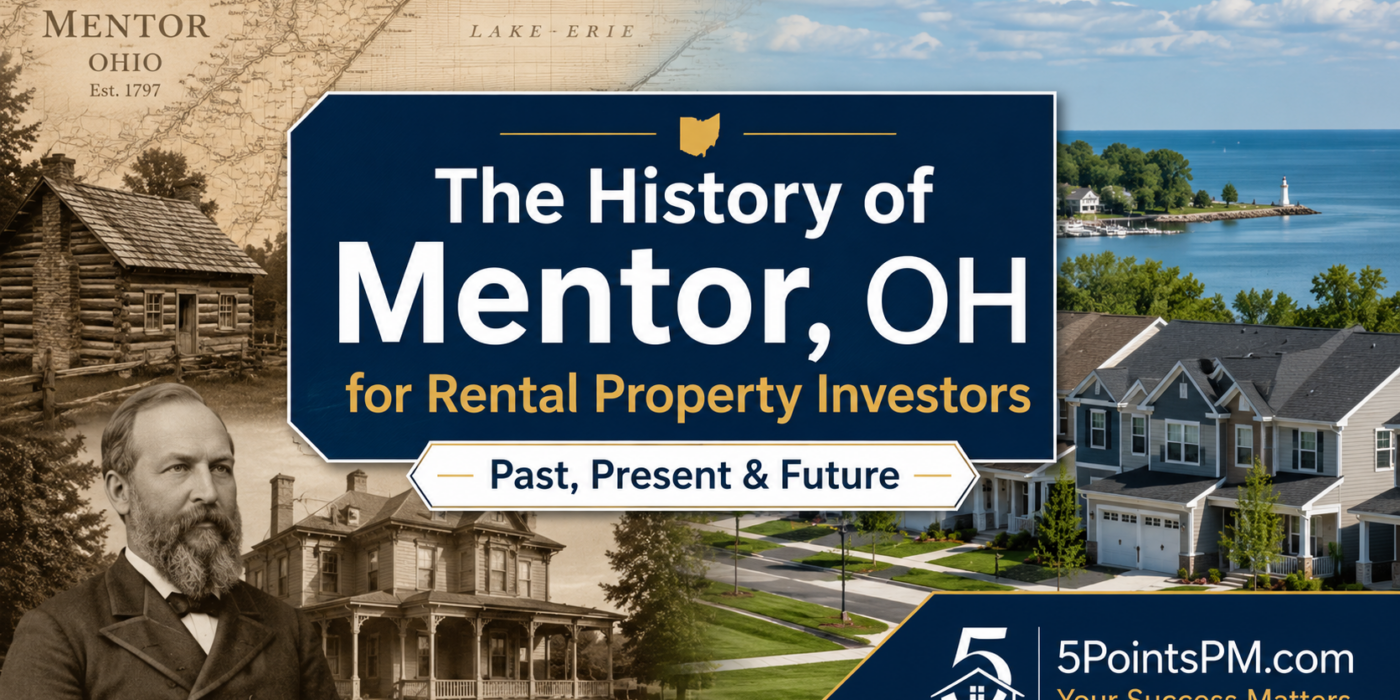
History Of Mentor Ohio
Categories5 Points Blog

From 1797 to Today: The History of Mentor, Ohio Through the Eyes of a Rental Property Investor

For a rental property investor, understanding a market means looking beyond today’s rent, purchase price, and projected cash flow.

You also want to understand why people live there, what supports the local economy, how the housing stock developed, and where the community may be headed next.

Mentor, Ohio offers an interesting example.

What began as a small Western Reserve settlement more than 225 years ago has developed into Lake County’s largest city, with nearly 50,000 residents, a substantial employment base, established neighborhoods, access to Lake Erie, and a housing market that remains distinctly different from many communities closer to Cleveland.

For investors evaluating rental property—and for owners comparing property management companies in Mentor OH—the history of Mentor helps explain much of what makes the market attractive today.

Mentor Begins: The Western Reserve and the First Settlers

Mentor’s modern story begins in 1797, when surveyor Charles Parker of the Connecticut Land Company built a cabin near what is now the Mentor Marsh area. Other settlers followed as northeastern Ohio’s Western Reserve gradually developed.

The area initially grew as an agricultural community.

That early development pattern matters even today.

Unlike neighborhoods built rapidly around dense urban centers, much of Mentor evolved with more land, wider residential areas, lower-density development, and room for the single-family housing that now dominates much of the city.

Over time, farms gave way to neighborhoods, commercial corridors, businesses, parks, industrial districts, and transportation infrastructure.

The result is a community where the typical rental investment opportunity often looks different from a traditional Cleveland duplex or small multifamily property.

Mentor is primarily a single-family-home market.

That distinction should influence how investors analyze properties, tenant demand, turnover costs, maintenance expectations, and property management.

James A. Garfield Puts Mentor on the National Map

Mentor gained national significance in the late nineteenth century through one of its most famous residents: James A. Garfield, who later became the 20th President of the United States.

Garfield purchased his Mentor farm in 1876. During the 1880 presidential election, thousands of supporters traveled to the property, where Garfield conducted what became famous as his “front porch campaign.” Railroad access brought visitors directly to the area.

Today, the James A. Garfield National Historic Site remains one of Mentor’s recognizable landmarks.

But from an investor’s perspective, Garfield’s story illustrates something larger.

Mentor has never simply been an anonymous suburb.

It developed its own identity, history, institutions, parks, neighborhoods, and community infrastructure. That local identity can matter when trying to attract tenants who are looking for more than simply the lowest available rent.

From Rural Community to Cleveland Suburb

The biggest transformation came during the twentieth century.

As Greater Cleveland expanded eastward, transportation improved and automobile ownership increased. Families could live farther from Cleveland’s employment centers while still having reasonable access to the metropolitan area.

Mentor gradually transitioned from farmland into a suburban residential and economic center.

The City of Mentor was formally incorporated in 1963, and subsequent decades brought continued residential, retail, and industrial development.

Single-family subdivisions expanded.

Retail grew along Mentor Avenue and other commercial corridors.

Manufacturing and industrial development created employment opportunities within Mentor itself rather than making the community entirely dependent on downtown Cleveland.

This is an important distinction for rental property investors.

Many suburbs function primarily as bedroom communities.

Mentor developed into both a place to live and a place to work.

The Employment Base Behind Mentor Rental Demand

Today, Mentor has a diverse business economy.

The city reports approximately 1,700 businesses, including more than 300 manufacturers, hundreds of retailers and restaurants, and a significant professional-services base. Manufacturing remains particularly important to Mentor’s economy.

Employers and industrial activity help support the fundamental ingredient every rental market needs:

households with jobs and income.

According to the U.S. Census Bureau, Mentor’s median household income for the 2020–2024 period was approximately $88,949. The city also reported a relatively short mean commute of approximately 21.6 minutes.

For landlords, those fundamentals can be more important than chasing the highest possible headline rent.

A rental market backed by employment, transportation access, established neighborhoods, recreation, shopping, and community amenities may provide a stronger foundation for long-term tenancy.

Mentor’s Housing Market Is Different From Many Cleveland Investment Markets

Mentor should not necessarily be approached with the same investment strategy an investor might use in Cleveland, Euclid, Maple Heights, or other inner-ring markets.

Approximately 84.7% of Mentor housing units were owner occupied during the 2020–2024 Census period.

That has several implications.

First, rental houses represent a smaller percentage of the overall housing market.

Second, renters shopping in Mentor may frequently be comparing a rental home with the experience of living in an owner-occupied suburban neighborhood.

Third, property condition matters.

Tenants paying suburban single-family rents generally expect a property that is safe, clean, functional, professionally maintained, and move-in ready.

This makes operational execution particularly important.

Painting, flooring, landscaping, roofing, HVAC, plumbing, electrical systems, appliances, exterior condition, cleanliness, and overall presentation can directly influence how quickly a property leases and the type of tenant it attracts.

This is one reason choosing among property management companies in Mentor OH should involve much more than simply comparing monthly management fees.

Mentor Rental Property Management Requires Local Knowledge

Mentor also operates a rental inspection program. The city resumed rental inspections after the pandemic-related pause, making property condition and compliance another consideration for local landlords.

An experienced property manager should understand not only leasing and rent collection, but also the local operational environment.

That includes:

  • Rental property inspections and compliance
  • Preventive maintenance
  • Seasonal Northeast Ohio weather issues
  • Turnover repairs
  • Vendor coordination
  • Rent positioning
  • Tenant screening
  • Lease enforcement
  • Property inspections
  • Owner communication
  • Long-term asset preservation

For an out-of-state investor in particular, good management becomes the infrastructure connecting the owner to the property.

The best property management companies in Mentor OH should therefore function as more than rent collectors. They should help protect the physical asset while keeping the property competitive in the local rental market.

What Mentor Looks Like Today

Mentor has now evolved from its rural beginnings into Lake County’s largest city.

The City of Mentor describes its evolution as a transition from a quiet farming community into a city of approximately 50,000 residents and 1,700 businesses.

The community combines residential neighborhoods with major employment centers, retail, parks, Lake Erie recreation, and regional transportation access.

Its housing values also reflect a different market tier from several traditional Northeast Ohio investor communities.

The Census Bureau reports a $247,700 median value for owner-occupied housing units for the 2020–2024 period and $1,239 median gross rent across all rental housing types.

Single-family asking rents can run higher than the overall Census gross-rent figure because those datasets include different housing types and methodologies.

For investors, that means Mentor is generally not a market where the strategy is simply:

Buy the cheapest house possible and chase maximum rent-to-price ratio.

The opportunity can instead come from balancing acquisition cost, neighborhood quality, tenant profile, appreciation potential, property condition, financing, rent, operating expenses, and long-term ownership.

Why Mentor’s Future Is Interesting for Rental Property Investors

Perhaps the most interesting part of Mentor’s story is what may happen next.

The city has already begun planning for it.

Mentor commissioned a Housing Study & Needs Analysis to examine existing housing inventory, demographic trends, economic conditions, housing gaps, and future housing opportunities. The stated goal is to encourage future growth while protecting the character and property values of the community.

That study identified demand for additional market-rate and workforce rental housing, particularly in walkable, amenity-rich environments.

Mentor is also developing its next long-range Comprehensive Land Use Plan. The city says the process will examine commercial and industrial areas for development and redevelopment opportunities and establish policies and zoning strategies intended to guide development for years to come.

That is significant for rental property owners.

Growing communities usually need a variety of housing choices.

Employees need somewhere to live.

Older homeowners may eventually downsize.

Younger households may want to rent before purchasing.

Families relocating into the area may want a single-family rental while deciding whether to buy.

Professionals working in the region may prefer suburban housing without immediately committing to homeownership.

Those demographic and economic movements can create opportunities for well-positioned rental properties.

Why We Are Positive About Mentor

No real estate market is guaranteed to appreciate, and every rental property should be evaluated on its own numbers.

But Mentor has several characteristics that we believe deserve investor attention.

It has an established employment base.

It has a high level of owner occupancy.

It has recognizable neighborhoods and community amenities.

It sits within the Greater Cleveland economy while maintaining a strong local business base of its own.

It offers access to Lake Erie, parks, recreation, shopping, major roads, and nearby employment.

And perhaps most importantly, city leaders are actively examining future housing needs rather than simply allowing the housing market to evolve without planning.

That combination does not guarantee investment success.

It does, however, create an interesting environment for investors who are willing to buy intelligently, maintain properties properly, and manage them professionally.

Buying the Property Is Only the Beginning

Finding a rental property is one step.

Operating it successfully for five, ten, or twenty years is another.

A strong property management strategy should help an owner protect occupancy, maintain the property, control expenses, communicate with tenants, manage repairs, comply with local requirements, and preserve the long-term value of the asset.

If you own rental property in Mentor—or are considering purchasing one—compare property management companies in Mentor OH based on the complete operation, not simply the advertised management percentage.

Ask how quickly maintenance requests are handled.

Ask how properties are inspected.

Ask how rental rates are determined.

Ask how tenants are screened.

Ask how turnovers are managed.

Ask how owners are updated.

Ask who handles local compliance issues.

And ask what happens when something goes wrong.

Those answers can ultimately matter more than a one- or two-percent difference in a management fee.

Looking Ahead: The Next Chapter of Mentor Real Estate

Mentor has traveled a remarkable path.

From Charles Parker’s cabin near the marsh in 1797…

to James Garfield’s famous front porch…

to twentieth-century suburban expansion…

to a modern city with thousands of businesses and established residential neighborhoods…

Mentor has continuously adapted.

The next phase appears likely to include redevelopment, new housing options, continued economic activity, and efforts to respond to changing housing needs.

For rental property investors, that makes Mentor a market worth watching.

The opportunity is not simply to purchase a house.

It is to own a well-located asset in an established Northeast Ohio community—and then operate that asset professionally.

At 5 Points Property Management, we help rental property owners navigate the day-to-day realities of owning investment property throughout Greater Cleveland and Northeast Ohio.

If you are researching property management companies in Mentor OH, considering buying a rental property in Mentor, or already own a home that needs professional management, we would be happy to discuss the property and your investment goals.

5PointsPM.com

Your Success Matters.

Cleveland Rental Property Investing
Categories5 Points Blog

Why Cleveland Rental Property Investors Still Need Human Property Managers

Technology has transformed the rental housing industry.

Owners can log into dashboards from anywhere in the world. Tenants can pay rent online. Maintenance requests can be submitted through mobile apps. Artificial intelligence can even answer basic questions around the clock.

Those innovations are making property management more efficient.

But here’s the reality:

Technology is a tool—not a replacement for experience.

When your investment property, cash flow, and long-term wealth are on the line, knowledgeable people still make better decisions than software alone.

Great Technology Still Needs Great People

Today’s property management software provides incredible convenience.

Owners enjoy:

  • 24/7 online access to financial reports
  • Real-time maintenance updates
  • Digital lease documents
  • Online rent collection
  • Performance dashboards

These tools save time.

But numbers alone don’t tell you what you should do next.

That’s where experienced property managers provide value.

A dashboard can show declining cash flow.

A seasoned property manager can explain why, recommend solutions, and help you build a strategy to improve returns.

AI Isn’t Customer Service

Many property management companies have introduced AI-powered maintenance chatbots to assist tenants.

These systems can be helpful for:

  • Collecting maintenance requests
  • Answering basic questions
  • Routing emergencies
  • Scheduling appointments

However, not every maintenance issue fits neatly into a chatbot conversation.

Tenants experiencing water leaks, heating failures, family emergencies, or unusual repair situations often want reassurance from another human being.

When technology creates frustration instead of solutions, resident satisfaction suffers.

The best companies use AI to improve efficiency—but still make experienced team members readily available whenever a tenant needs personalized assistance.

Experience Sees What Software Doesn’t

Artificial intelligence analyzes data.

Experienced property managers analyze situations.

There’s a difference.

A property manager with twenty years of Cleveland market experience understands things no spreadsheet can fully capture, including:

  • Which streets consistently outperform others
  • Which contractors reliably deliver quality work
  • Which renovations generate the highest return on investment
  • Which applicants look excellent on paper but raise practical concerns during the leasing process
  • When it’s smarter to retain a struggling tenant instead of filing an expensive eviction
  • How to navigate changing market conditions through both strong and challenging economic cycles

That type of judgment comes from thousands of real-world decisions—not simply historical data.

Investing Is Bigger Than Individual Decisions

Successful investing isn’t just about filling vacancies.

It’s about building a long-term strategy.

Experienced property managers help investors:

  • Prioritize capital improvements
  • Increase rents strategically
  • Reduce operating expenses
  • Protect property values
  • Minimize vacancy
  • Plan acquisitions
  • Avoid costly mistakes

Technology may optimize one task.

An experienced advisor connects all of those decisions into a strategy designed to build wealth over decades.

Local Knowledge Still Matters

The internet has never contained more real estate information than it does today.

Unfortunately, not all of it is accurate, current, or applicable to your neighborhood.

AI tools can summarize large amounts of information quickly, but they don’t personally inspect homes, meet contractors, attend court hearings, or walk neighborhoods every day.

Local property managers do.

They understand which streets are improving, which contractors consistently perform, how local municipalities enforce housing regulations, and what today’s renters actually want—not just what a national database suggests.

When you’re investing hundreds of thousands of dollars, that local knowledge can be invaluable.

The Best Future Is Human + Technology

The future of property management isn’t people versus technology.

It’s people using technology better than ever before.

Smart software makes communication faster.

AI helps automate repetitive tasks.

Digital tools improve transparency.

But experienced professionals still provide the judgment, relationships, local expertise, and strategic thinking that technology alone cannot replace.

The Bottom Line

Technology has made owning rental property easier than ever.

It has not made experienced property managers obsolete.

In fact, it has made them even more important and valuable, as investors need help cutting through even more noise and misinformation than ever before.

The best investment decisions still require human judgment, local market knowledge, and years of practical experience.

The most successful Cleveland investors don’t choose between technology and people.

They choose a property management company that combines both—using modern tools to improve efficiency while relying on experienced professionals to protect their investments, maximize returns, and help them build lasting wealth.

CategoriesFinance News

Top Finance News For Investors Today

There’s a lot happening in the latest finance news. Especially when it comes to real estate and mortgages.

Let’s dive into the top finance news today to see what the potential effects are behind the big headlines…

Nvidia Stock Performance

It seems like the entire stock market and US economy has been riding on the hopes of AI recently. Now the golden child of the NASDAQ, Nvidia seems to be showing cracks. Top investors are now turning bearish on the stock, with NVDA down 12% in the past month according to the latest stock market news headlines. 

This may be just the wake up call that investors need to return to disciplined and sensible investing in tangible assets like real estate. Which should in turn bolster the positions of property investors. 

Is The New 50 Year Mortgage A Good Deal?

The current administration has floated extending mortgage terms to as long as 50 years!

While this would make the monthly payments much more affordable for young homebuyers, and create more positive cash flow for investors in the short term, there are potential downsides. 

For one, this would likely support higher property prices, and interest rates, which may not create true affordability for retail home buyers. 

Secondly, on a 50 year mortgage, borrowers would end up paying around double the interest, or an extra $400,000 in interest on the average priced home over the life of their loan. Effectively meaning they’ve paid for the home 3x over by the time they retire this debt. 

What Is A Portable Mortgage?

One of the latest forms of exotic mortgage according to coverage by Yahoo Finance news is the Portable Mortgage. 

The premise is that borrowers could reduce finance costs, by simply moving their mortgage debt from property to property when they buy and sell. 

This could potentially save thousands of dollars in transactional costs. However, you had better check that fine print and all the rules before you sign up for one. 

Is A New Fannie Mae IPO In The Works?

Bill Ackman just laid out his three step proposal for relisting Fannie Mae and Freddie Mac on the stock exchange. 

This would follow the government considering all of the bail out money from 2008 satisfied, and open up public investment in the $400B behemoth, while giving institutional investors a huge opportunity to cash out.

Figure Home Equity Lines Of Credit

Figure boasts becoming the number one non bank source for HELOCs in the US. 

They offer fast funding, online, with lines of credit from $15k to $750k. Worth looking into for your next home remodeling project or tapping into extra funds to renovate or maintain your rental properties. 

Which States Are Eliminating Property Taxes?

Property taxes are a substantial cost for real estate investors. Many, if not most people now agree that property taxes have effectively changed homeownership into long term renting. Meaning you’ll never be free of payments, even when you pay off your mortgage. 

Several states have been looking into how they can get rid of property taxes, including FL, OH, and TX. 

In fact, in the latest finance news, Texas Governor Greg Abbott has declared property tax relief an emergency. However, while he has made a variety of efforts to offset taxes and cap them, he says that it is the local counties which are doing the taxing which need to stop, not the state. 

Property Holding Costs Hit $16,000 Per Year

New data from Zillow shows holding costs for homeowners have been skyrocketing. Maintenance makes up the largest portion of this, with about $11,000 a year needed to maintain the average home. 

Inflation in property taxes, utilities, and insurances isn’t helping either. With some cities seeing a 79% spike in insurance costs. 

Check out more on how to manage the maintenance and profitability of your rental properties in 5 Points Property Management’s new education series for investors. The series of expert tips for investors will be featured on our brand new YouTube channel, which is set to launch in December 2025.