
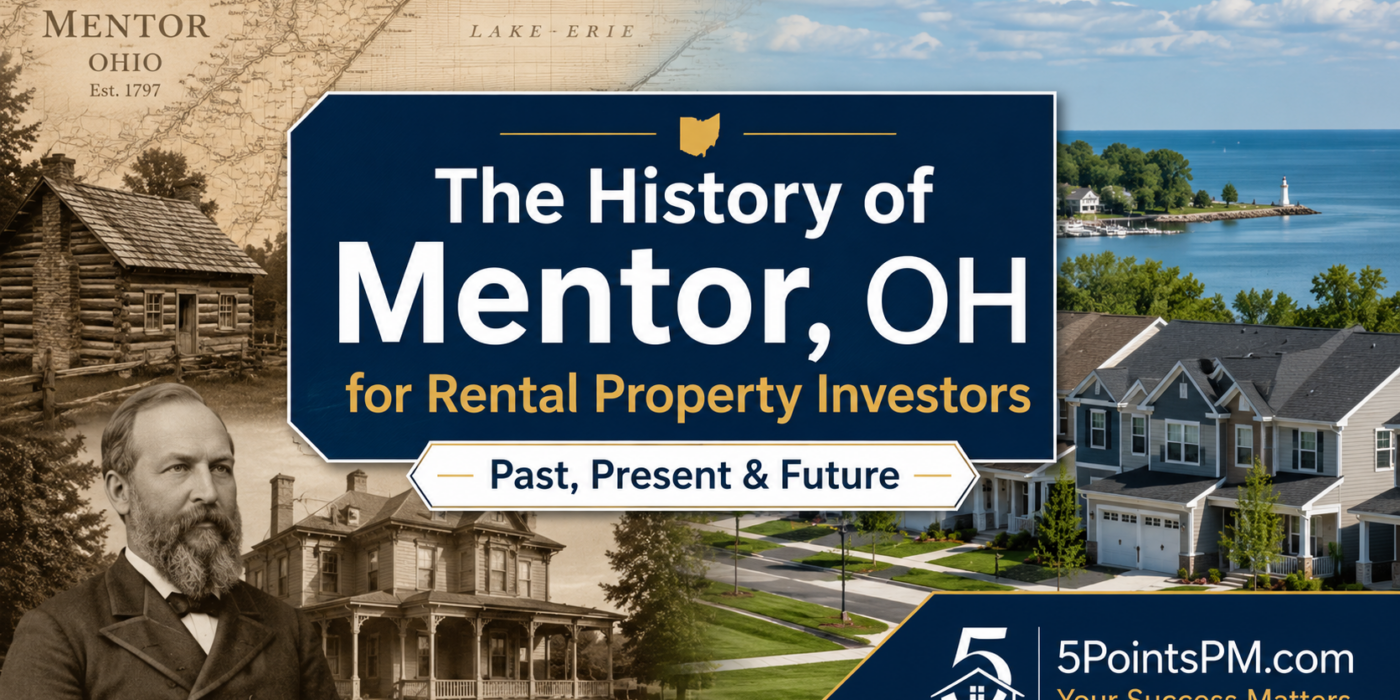
For a rental property investor, understanding a market means looking beyond today’s rent, purchase price, and projected cash flow.
You also want to understand why people live there, what supports the local economy, how the housing stock developed, and where the community may be headed next.
Mentor, Ohio offers an interesting example.
What began as a small Western Reserve settlement more than 225 years ago has developed into Lake County’s largest city, with nearly 50,000 residents, a substantial employment base, established neighborhoods, access to Lake Erie, and a housing market that remains distinctly different from many communities closer to Cleveland.
For investors evaluating rental property—and for owners comparing property management companies in Mentor OH—the history of Mentor helps explain much of what makes the market attractive today.
Mentor Begins: The Western Reserve and the First Settlers
Mentor’s modern story begins in 1797, when surveyor Charles Parker of the Connecticut Land Company built a cabin near what is now the Mentor Marsh area. Other settlers followed as northeastern Ohio’s Western Reserve gradually developed.
The area initially grew as an agricultural community.
That early development pattern matters even today.
Unlike neighborhoods built rapidly around dense urban centers, much of Mentor evolved with more land, wider residential areas, lower-density development, and room for the single-family housing that now dominates much of the city.
Over time, farms gave way to neighborhoods, commercial corridors, businesses, parks, industrial districts, and transportation infrastructure.
The result is a community where the typical rental investment opportunity often looks different from a traditional Cleveland duplex or small multifamily property.
Mentor is primarily a single-family-home market.
That distinction should influence how investors analyze properties, tenant demand, turnover costs, maintenance expectations, and property management.
James A. Garfield Puts Mentor on the National Map
Mentor gained national significance in the late nineteenth century through one of its most famous residents: James A. Garfield, who later became the 20th President of the United States.
Garfield purchased his Mentor farm in 1876. During the 1880 presidential election, thousands of supporters traveled to the property, where Garfield conducted what became famous as his “front porch campaign.” Railroad access brought visitors directly to the area.
Today, the James A. Garfield National Historic Site remains one of Mentor’s recognizable landmarks.
But from an investor’s perspective, Garfield’s story illustrates something larger.
Mentor has never simply been an anonymous suburb.
It developed its own identity, history, institutions, parks, neighborhoods, and community infrastructure. That local identity can matter when trying to attract tenants who are looking for more than simply the lowest available rent.
From Rural Community to Cleveland Suburb
The biggest transformation came during the twentieth century.
As Greater Cleveland expanded eastward, transportation improved and automobile ownership increased. Families could live farther from Cleveland’s employment centers while still having reasonable access to the metropolitan area.
Mentor gradually transitioned from farmland into a suburban residential and economic center.
The City of Mentor was formally incorporated in 1963, and subsequent decades brought continued residential, retail, and industrial development.
Single-family subdivisions expanded.
Retail grew along Mentor Avenue and other commercial corridors.
Manufacturing and industrial development created employment opportunities within Mentor itself rather than making the community entirely dependent on downtown Cleveland.
This is an important distinction for rental property investors.
Many suburbs function primarily as bedroom communities.
Mentor developed into both a place to live and a place to work.
The Employment Base Behind Mentor Rental Demand
Today, Mentor has a diverse business economy.
The city reports approximately 1,700 businesses, including more than 300 manufacturers, hundreds of retailers and restaurants, and a significant professional-services base. Manufacturing remains particularly important to Mentor’s economy.
Employers and industrial activity help support the fundamental ingredient every rental market needs:
households with jobs and income.
According to the U.S. Census Bureau, Mentor’s median household income for the 2020–2024 period was approximately $88,949. The city also reported a relatively short mean commute of approximately 21.6 minutes.
For landlords, those fundamentals can be more important than chasing the highest possible headline rent.
A rental market backed by employment, transportation access, established neighborhoods, recreation, shopping, and community amenities may provide a stronger foundation for long-term tenancy.
Mentor’s Housing Market Is Different From Many Cleveland Investment Markets
Mentor should not necessarily be approached with the same investment strategy an investor might use in Cleveland, Euclid, Maple Heights, or other inner-ring markets.
Approximately 84.7% of Mentor housing units were owner occupied during the 2020–2024 Census period.
That has several implications.
First, rental houses represent a smaller percentage of the overall housing market.
Second, renters shopping in Mentor may frequently be comparing a rental home with the experience of living in an owner-occupied suburban neighborhood.
Third, property condition matters.
Tenants paying suburban single-family rents generally expect a property that is safe, clean, functional, professionally maintained, and move-in ready.
This makes operational execution particularly important.
Painting, flooring, landscaping, roofing, HVAC, plumbing, electrical systems, appliances, exterior condition, cleanliness, and overall presentation can directly influence how quickly a property leases and the type of tenant it attracts.
This is one reason choosing among property management companies in Mentor OH should involve much more than simply comparing monthly management fees.
Mentor Rental Property Management Requires Local Knowledge
Mentor also operates a rental inspection program. The city resumed rental inspections after the pandemic-related pause, making property condition and compliance another consideration for local landlords.
An experienced property manager should understand not only leasing and rent collection, but also the local operational environment.
That includes:
- Rental property inspections and compliance
- Preventive maintenance
- Seasonal Northeast Ohio weather issues
- Turnover repairs
- Vendor coordination
- Rent positioning
- Tenant screening
- Lease enforcement
- Property inspections
- Owner communication
- Long-term asset preservation
For an out-of-state investor in particular, good management becomes the infrastructure connecting the owner to the property.
The best property management companies in Mentor OH should therefore function as more than rent collectors. They should help protect the physical asset while keeping the property competitive in the local rental market.
What Mentor Looks Like Today
Mentor has now evolved from its rural beginnings into Lake County’s largest city.
The City of Mentor describes its evolution as a transition from a quiet farming community into a city of approximately 50,000 residents and 1,700 businesses.
The community combines residential neighborhoods with major employment centers, retail, parks, Lake Erie recreation, and regional transportation access.
Its housing values also reflect a different market tier from several traditional Northeast Ohio investor communities.
The Census Bureau reports a $247,700 median value for owner-occupied housing units for the 2020–2024 period and $1,239 median gross rent across all rental housing types.
Single-family asking rents can run higher than the overall Census gross-rent figure because those datasets include different housing types and methodologies.
For investors, that means Mentor is generally not a market where the strategy is simply:
Buy the cheapest house possible and chase maximum rent-to-price ratio.
The opportunity can instead come from balancing acquisition cost, neighborhood quality, tenant profile, appreciation potential, property condition, financing, rent, operating expenses, and long-term ownership.
Why Mentor’s Future Is Interesting for Rental Property Investors
Perhaps the most interesting part of Mentor’s story is what may happen next.
The city has already begun planning for it.
Mentor commissioned a Housing Study & Needs Analysis to examine existing housing inventory, demographic trends, economic conditions, housing gaps, and future housing opportunities. The stated goal is to encourage future growth while protecting the character and property values of the community.
That study identified demand for additional market-rate and workforce rental housing, particularly in walkable, amenity-rich environments.
Mentor is also developing its next long-range Comprehensive Land Use Plan. The city says the process will examine commercial and industrial areas for development and redevelopment opportunities and establish policies and zoning strategies intended to guide development for years to come.
That is significant for rental property owners.
Growing communities usually need a variety of housing choices.
Employees need somewhere to live.
Older homeowners may eventually downsize.
Younger households may want to rent before purchasing.
Families relocating into the area may want a single-family rental while deciding whether to buy.
Professionals working in the region may prefer suburban housing without immediately committing to homeownership.
Those demographic and economic movements can create opportunities for well-positioned rental properties.
Why We Are Positive About Mentor
No real estate market is guaranteed to appreciate, and every rental property should be evaluated on its own numbers.
But Mentor has several characteristics that we believe deserve investor attention.
It has an established employment base.
It has a high level of owner occupancy.
It has recognizable neighborhoods and community amenities.
It sits within the Greater Cleveland economy while maintaining a strong local business base of its own.
It offers access to Lake Erie, parks, recreation, shopping, major roads, and nearby employment.
And perhaps most importantly, city leaders are actively examining future housing needs rather than simply allowing the housing market to evolve without planning.
That combination does not guarantee investment success.
It does, however, create an interesting environment for investors who are willing to buy intelligently, maintain properties properly, and manage them professionally.
Buying the Property Is Only the Beginning
Finding a rental property is one step.
Operating it successfully for five, ten, or twenty years is another.
A strong property management strategy should help an owner protect occupancy, maintain the property, control expenses, communicate with tenants, manage repairs, comply with local requirements, and preserve the long-term value of the asset.
If you own rental property in Mentor—or are considering purchasing one—compare property management companies in Mentor OH based on the complete operation, not simply the advertised management percentage.
Ask how quickly maintenance requests are handled.
Ask how properties are inspected.
Ask how rental rates are determined.
Ask how tenants are screened.
Ask how turnovers are managed.
Ask how owners are updated.
Ask who handles local compliance issues.
And ask what happens when something goes wrong.
Those answers can ultimately matter more than a one- or two-percent difference in a management fee.
Looking Ahead: The Next Chapter of Mentor Real Estate
Mentor has traveled a remarkable path.
From Charles Parker’s cabin near the marsh in 1797…
to James Garfield’s famous front porch…
to twentieth-century suburban expansion…
to a modern city with thousands of businesses and established residential neighborhoods…
Mentor has continuously adapted.
The next phase appears likely to include redevelopment, new housing options, continued economic activity, and efforts to respond to changing housing needs.
For rental property investors, that makes Mentor a market worth watching.
The opportunity is not simply to purchase a house.
It is to own a well-located asset in an established Northeast Ohio community—and then operate that asset professionally.
At 5 Points Property Management, we help rental property owners navigate the day-to-day realities of owning investment property throughout Greater Cleveland and Northeast Ohio.
If you are researching property management companies in Mentor OH, considering buying a rental property in Mentor, or already own a home that needs professional management, we would be happy to discuss the property and your investment goals.
5PointsPM.com
Your Success Matters.