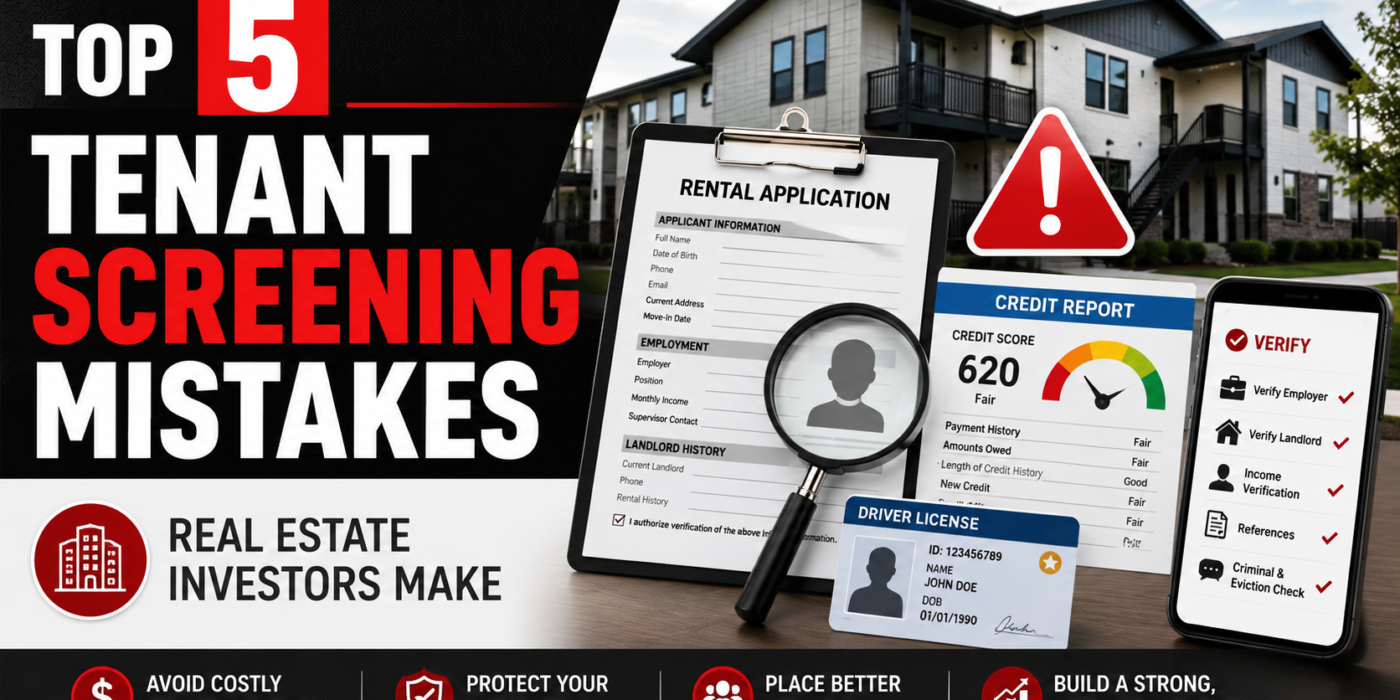
A rental property can look like a great investment on paper, but the wrong tenant can quickly turn a good property into a bad investment.
Unpaid rent, property damage, lease violations, legal expenses, and months of lost income can cost an investor thousands of dollars. That is why tenant screening should never be treated as simply pulling a credit report and checking whether an applicant has a decent score.
Good tenant screening is about verification, consistency, and understanding the complete picture.
Unfortunately, even experienced real estate investors make mistakes during the screening process.
Here are five of the biggest.
1. Running the Wrong Background Checks — or Using Information You Shouldn’t
One of the most dangerous tenant-screening mistakes is assuming:
“It’s public information, so I can use it.”
Not necessarily.
Landlords have to operate within federal, state, and local fair-housing, consumer-reporting, and privacy laws. Depending on the jurisdiction and circumstances, restrictions can apply to what information may be obtained, how far back information can be considered, and how that information may be used.
Criminal-history screening deserves particular attention. A blanket policy automatically rejecting anyone with any criminal history can create Fair Housing Act concerns, and state or local laws may impose additional restrictions.
Consumer reports used for tenant screening are also regulated by the Fair Credit Reporting Act (FCRA). If an investor takes an adverse action based partly or entirely on a consumer report—such as denying the application, increasing the security deposit, or requiring a co-signer—FCRA notice requirements may apply.
Investors should also be extremely careful about digging for information connected to protected characteristics or allowing information found online to influence a rental decision improperly.
The lesson: Don’t become an amateur private investigator.
Use a reputable tenant-screening provider, establish written screening criteria, apply those criteria consistently to every applicant, and make sure your process complies with federal, state, and local law.
When you’re unsure whether particular information can legally be requested, searched, or considered, consult qualified legal counsel familiar with landlord-tenant and fair-housing law in your jurisdiction.
2. Failing to Verify That All of the Information Actually Belongs to the Applicant
This is one of the most overlooked parts of tenant screening.
You order a credit or background report, receive several pages of information, see a credit score, and start making a decision.
But first ask:
Does everything on this report actually belong to this person?
Tenant-screening reports can contain errors. The FTC and CFPB have both warned about inaccurate information appearing in tenant background reports, including records that can be incorrectly associated with an applicant.
Before evaluating the report, compare the identifying information throughout the application and screening documents.
Look at:
- Full legal name and spelling
- Previous names or aliases
- Date of birth
- Social Security information where lawfully obtained and used
- Current address
- Previous addresses
- Employment information
- Rental history
- Other identifying information contained in the report
Then ask whether the information adds up.
For example, if an applicant says they have lived in Cleveland for five years but the credit report shows recent addresses in three other states, that does not automatically mean the applicant should be rejected.
It means:
Ask another question.
There may be a perfectly reasonable explanation—or you may have discovered incorrect information, identity theft, an incomplete application, or information belonging to someone with a similar name.
Screening isn’t just about finding information.
It’s about verifying that you’re looking at the right person’s information in the first place.
3. Failing to Actually Verify Employment and Income
An applicant writing an employer’s name and telephone number on an application is not employment verification.
Investors sometimes see:
Employer: ABC Manufacturing
Income: $5,200 per month
…and move on.
That is not enough.
Employment should be independently verified whenever legally appropriate.
Confirm things such as:
- Does the company actually exist?
- Does the applicant actually work there?
- Is the contact information legitimate?
- Does the job title reasonably match what was reported?
- Is the income consistent with the documentation provided?
- How long has the applicant worked there?
Whenever possible, obtain appropriate written verification in addition to verbal confirmation.
Pay stubs, employment verification documents, tax documentation for self-employed applicants, bank records when appropriate and lawfully requested, and other acceptable documentation can help establish whether the applicant’s claimed income is real.
Also beware of one increasingly common problem:
Fake verification contacts.
Don’t assume the phone number written on the application belongs to the company’s HR department.
Independently locate the employer’s legitimate contact information whenever possible.
A professional screening process doesn’t merely ask applicants for information.
It verifies it.
4. Failing to Call Previous Landlords — and Verify the Landlord Is Real
Rental history can tell you things that a credit score never will.
Did the tenant pay on time?
Did they take care of the property?
Were there repeated lease violations?
Did unauthorized people or animals occupy the property?
Did the tenant provide proper notice before leaving?
Would the landlord rent to them again?
Those are important questions.
But there is another step many investors miss:
Verify the landlord.
An applicant who knows you’re going to call a “previous landlord” could potentially give you the telephone number of a friend or family member.
Before relying on a landlord reference, independently verify that the person you are speaking with has a legitimate connection to the property.
Property ownership records, management-company information, previous addresses appearing in the applicant’s screening records, and other lawful sources can help you confirm the relationship.
When possible, obtain written rental verification as part of the file as well.
And don’t rely exclusively on the current landlord.
There are situations where a current landlord may have an incentive to give a troublesome tenant a glowing recommendation simply because they want that tenant to move.
A previous landlord who already received possession of the property may sometimes provide a more candid assessment.
The goal isn’t to find reasons to reject someone.
The goal is to verify the history the applicant provided.
5. Looking at the Credit Score Instead of the Credit History
This may be the biggest financial screening mistake of all.
Suppose one applicant has a 690 credit score and another has a 640.
Which is the better tenant?
You don’t know yet.
A credit score is only a number summarizing certain information contained in a credit file. It doesn’t tell the complete financial story.
Instead of asking only:
“What’s the score?”
Ask:
“Why is the score what it is?”
Look deeper.
How does the applicant handle housing obligations?
Housing-related payment history can tell you more about rental risk than whether someone was late on an unrelated account several years ago.
How much debt are they carrying?
A person can earn good money but still have very little available cash every month because of car payments, credit cards, loans, child-support obligations, or other recurring expenses.
Are there recent late payments?
One old problem followed by several years of responsible behavior tells a different story than multiple late payments during the last six months.
Is there a pattern?
One isolated collection is different from ten collections.
A past financial setback is different from an ongoing pattern of failing to pay obligations.
What is happening right now?
An applicant’s current income, debt obligations, housing expenses, reserves, and payment patterns often matter more than simply chasing a particular credit-score cutoff.
Two people with the same credit score can have completely different financial situations.
Smart investors don’t screen a number.
They screen the story behind the number.
Tenant Screening Is About Verification, Not Assumptions
The purpose of tenant screening isn’t to find the applicant with the highest credit score.
It’s to make an informed, consistent, legally compliant decision about whether someone appears capable and willing to meet the obligations of the lease.
That means following a repeatable process:
Verify identity.
Verify income.
Verify employment.
Verify rental history.
Understand the credit history.
Follow fair-housing and consumer-reporting laws.
Document the decision.
And most importantly:
Apply the same written screening standards consistently to every applicant.
A few extra minutes spent verifying an application can potentially save months of headaches after someone moves into the property.
For real estate investors, tenant screening shouldn’t be viewed as paperwork.
It is risk management for one of your most valuable assets.
A Final Note for Rental Property Owners
Tenant-screening laws are not identical everywhere. Federal requirements such as the Fair Housing Act and Fair Credit Reporting Act may apply, while states and municipalities can impose additional restrictions. The FTC confirms that landlords using consumer reports for housing decisions have specific obligations under the FCRA, particularly when taking an adverse action based on a screening report.
Before establishing or changing your screening standards, make sure your policies comply with the laws where your rental property is located.
Good property management begins long before a tenant receives the keys. It begins with a disciplined screening process.